Chapel
At the heart of the Palace, the Chapel, perfectly proportional to the building, connects the Baroque architect to the origins of Roman architecture in the most faithful way… In fact, Palácio Ludovice follows the proportions defined by Leonardo da Vinci’s Vitruvian Man: “For any building to be beautiful,” wrote Vitruvius, “it must have symmetry and perfect proportions, as found in nature. And since the most perfect object in nature is man, a perfect building must have the proportions of the human body.”
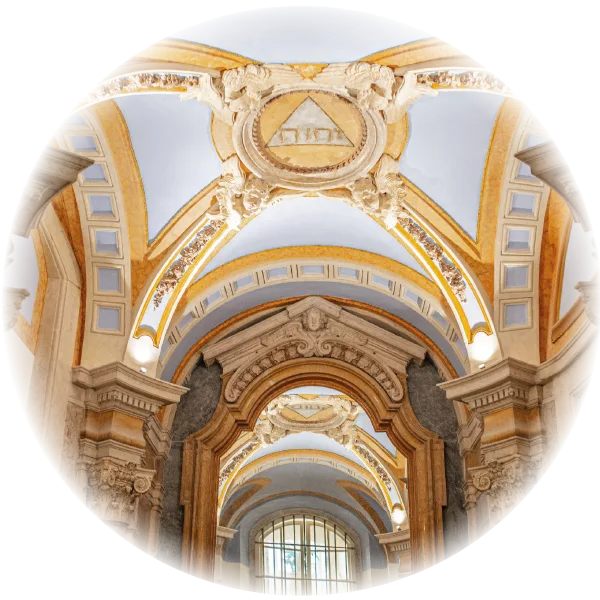
Looking up, the dome’s medallion marks the center of this small rectangular chapel. Inscribed within it is an equilateral triangle, with all sides equal in perfect pyramidal symmetry—the Holy Spirit, where the name Jehovah is written in Hebrew, the Great Architect of the Universe, the supreme symbol of the four sacred elements (air, water, earth, and fire). The chapel has four polished pink marble columns, matching the number of sacred elements.
Now, examining the floor, its pattern mirrors that of the Mafra Library—both in design and colors (polychromy). Directly beneath the dome’s medallion is the monogram of João Federico Ludovice, with his initials—JFL—duplicated in inverse symmetry. Why duplicated? Because each set of letters represents Ludovice’s material (Man) and spiritual (Soul) essence.
But the most beautiful aspect of this ensemble, the most marvelous message, is the connection that from his hand links Ludovice to the All—the earthly architect positioned directly beneath the architect of the Universe.
Above the left portal, facing the altar, is the sixteen-pointed Star indicating Bethlehem, the birthplace of Jesus, encapsulating in a unique visual discourse the grand cycle of life, death, and the beyond of a man whose work endures to this day—proportionality, symmetry, harmony, and balance.
Looking up, the dome’s medallion marks the center of this small rectangular chapel. Inscribed within it is an equilateral triangle, with all sides equal in perfect pyramidal symmetry—the Holy Spirit, where the name Jehovah is written in Hebrew, the Great Architect of the Universe, the supreme symbol of the four sacred elements (air, water, earth, and fire). The chapel has four polished pink marble columns, matching the number of sacred elements.
Now, examining the floor, its pattern mirrors that of the Mafra Library—both in design and colors (polychromy). Directly beneath the dome’s medallion is the monogram of João Federico Ludovice, with his initials—JFL—duplicated in inverse symmetry. Why duplicated? Because each set of letters represents Ludovice’s material (Man) and spiritual (Soul) essence.
But the most beautiful aspect of this ensemble, the most marvelous message, is the connection that from his hand links Ludovice to the All—the earthly architect positioned directly beneath the architect of the Universe.
Above the left portal, facing the altar, is the sixteen-pointed Star indicating Bethlehem, the birthplace of Jesus, encapsulating in a unique visual discourse the grand cycle of life, death, and the beyond of a man whose work endures to this day—proportionality, symmetry, harmony, and balance.
Related points